

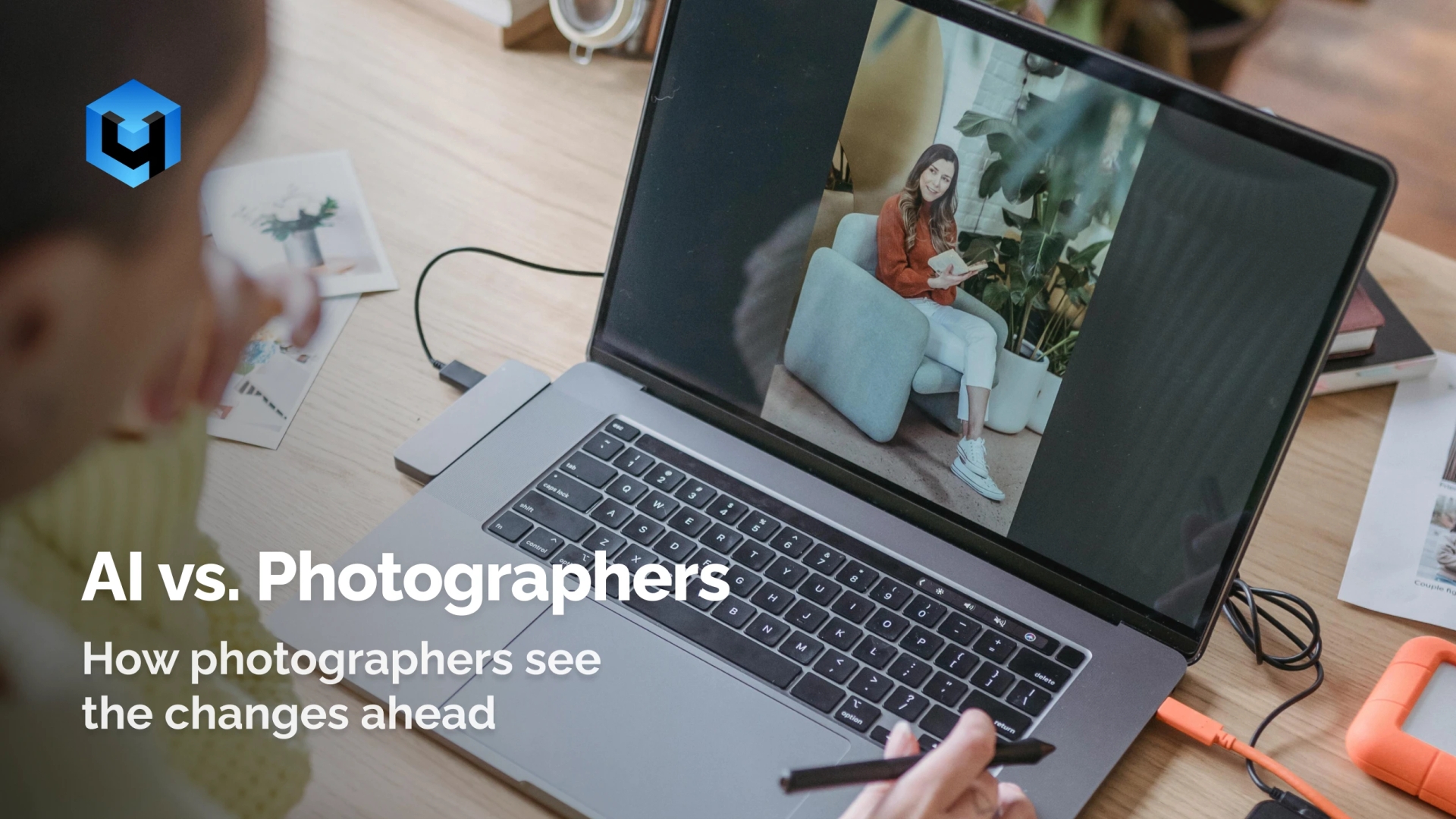
Recently, the topic of competition between generative AI and photographers has been increasingly discussed within the professional community. “A Coca-Cola bottle shoot 50,000 kilometers away in the Arctic will never happen again; it can simply be rendered and a background added,” fellow photographers write.
Social media is already full of portraits created using neural network models. Companies actively working with AI in photography are releasing products that allow users to turn any of their portraits into a high-quality photo for use in a résumé, on a corporate website, a personal social media profile, or a dating site.
Many photographers express concerns that such AI products will leave them without work. Let’s try to look at this issue from different angles.
STRENGTHS OF GENERATIVE AI:
Speed: to get a portrait with its help, you don’t even need to leave home. It’s enough to take a selfie with a smartphone camera. The neural network can dress you, style your hair, and apply makeup in just a few seconds, and there you are, uploading your photo to your profile.
Trends: rapid analysis of information flows is highly likely to allow neural network models to always stay current, navigate existing trends, and produce content that matches the “spirit of the time,” whether it is product photography or a portrait.
Price: organizing a high-quality photoshoot is quite an expensive process (studio rental, equipment, photographer’s work, and retouching). There is a high probability that applications for generating classic portraits or simple product photography (for example, for a catalog) will soon become very affordable and may end up on almost every smartphone.
AI performs well in standardized formats. Hiring people to create typical photographs will soon seem excessive. If the image you need does not require a creative vision or proof of realism, it is much easier to generate it without leaving the couch. Fields such as stock photography, where the consumer values depersonalized content, are also very likely to move into the hands of AI.
Sergio Boccasile, art director and photographer | Milan, Italy:
AI’s ability to create photorealistic renders from simple CAD files or sketches eliminates the need for physical studios, lighting, and shipping prototypes. Basic lifestyle shoots (for example, a person in a T-shirt in a park) are already being replaced by AI, which allows brands to change ethnicity, age, and background without a photoshoot. Simple standardized portraits are increasingly being created using AI based on a few selfies, delivering professional results while saving time and money for large companies.
The point is that these areas are focused on efficiency and cost reduction more than on artistic uniqueness. AI excels at repetitive, predictable tasks where “perfection” is subject to a mathematical standard.
WHAT ADVANTAGES DO PROFESSIONAL PHOTOGRAPHERS HAVE:
Being present in the moment: wedding, sports, and reportage photography, whether it is covering a news event, a love story, or the birth of a child, is an area where a live photographer, fully engaged in what is happening, will always be needed.
Human connection: for a huge number of people, a photoshoot is not only a way to get images, but also an important process of personal раскрытие, an opportunity to see themselves a little “from the outside,” through the eyes of a professional and creative person. A great photographer not only has their own “vision,” which attracts clients, but also builds warm communication, creates an atmosphere in which people gain special experiences and a certain emotional experience. Photo generation online cannot replace this.
Authenticity: the more generated content appears around us, the more valuable photographs confirming the authenticity of a specific person, phenomenon, or object will become. Even in sales, there are many situations where it is important for the consumer to know that what they see in the photo really looks exactly like that.
Creativity: photography is, above all, an art. Regardless of the complexity and cost of equipment, a photographer has hundreds of ways to convey feelings, emotions, and their own ideas through an image. The “human aspect” of photography is what makes it irreplaceable in the age of artificial intelligence.
Omar Ortiz, photographer| Qatar:
AI is not capable of replacing a human in capturing events that are spontaneous, sincere, and uncontrollable, such as weddings, birthdays, corporate events, or any human gatherings. Special moments still need to be captured authentically.
Sergio Boccasile, art director and photographer | Milan, Italy:
AI will struggle where the unpredictability of the moment matters. In photojournalism and documentary photography, the value lies in “truth.” AI generates images; it does not “bear witness” to events. The ethical and historical significance of a real person documenting a conflict or social crisis cannot be reproduced by an algorithm.
Art is a dialogue between two consciousnesses. AI can create aesthetically pleasing images, but it lacks intentionality and a personal narrative that collectors and galleries value. Human presence ensures authenticity and responsibility. We value these photographs precisely because a person was there and captured a fleeting, unrepeatable reality.
More than a century and a half ago, photography burst into human life, and many thinkers of that time proclaimed the death of painting. However, over time we saw that it freed painting from the need to accurately copy reality and pushed it toward the search for new forms of expression. This is how Impressionism, Cubism, Abstractionism, and other movements were born. At the same time, artists began using photography as an auxiliary tool, studying motion through Muybridge’s frames and experimenting with composition and angles, while photography itself eventually became an independent art form.
Photography took on the function of precise documentary depiction, allowing painting to focus on emotions, light, color, and subjective perception of the world. Photography taught us to see the world through unusual angles and asymmetrical compositions that had previously been impossible in painting. Thus, photography did not kill painting, but gave it a powerful impetus for development, redirecting its search toward subjective perception and new forms.
We believe that something similar will happen with the introduction of generative technologies and other AI tools into our lives and work. Already now, we see how quickly the quality of photo editing is improving and how photographers around the world are freeing up a significant amount of time for creativity and new projects.
Undoubtedly, the photography market is facing changes. Artificial intelligence will replace typical work that carries no emotional or socially significant, “human” load; it will perform utilitarian functions. But the thinking, searching artist, the true master of photography, will become even more in demand and will find unexpected, new ways of working with images.