

There’s a lot of AI in photography today.
Honestly, too much.
Culling, retouching, enhancement, “make it perfect in one click.”
But after the initial excitement, many photographers face the same problem: there are tools, but no coherent workflow.
Arams was created to solve exactly this problem.
Not Just Another AI. A Unified Workflow
Most solutions on the market solve tasks in isolation. One AI for culling. Another tool for retouching. Different apps, exports, imports, lost context.
Photographers end up spending more time managing software than working with images.
Arams works differently.
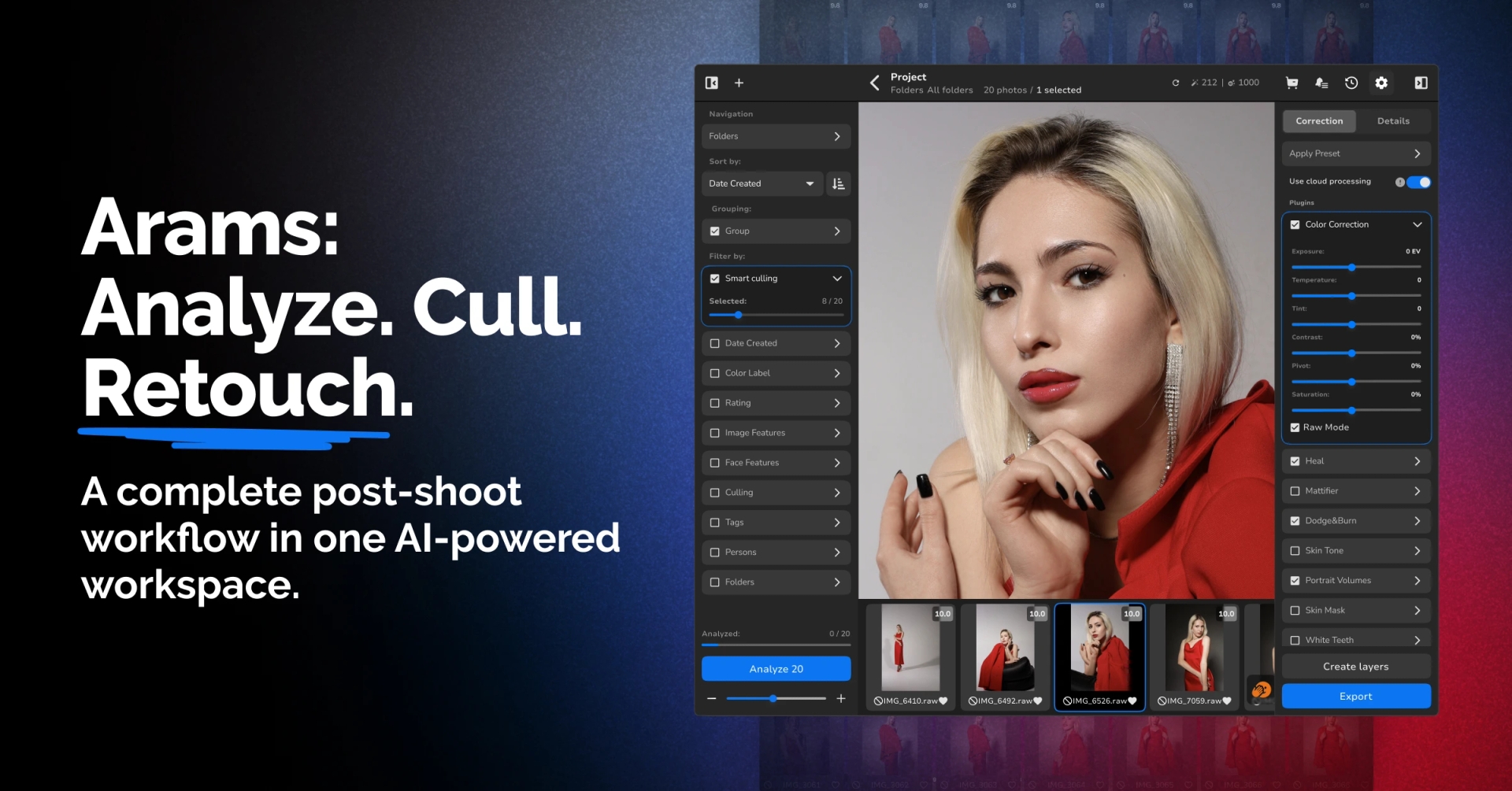
It’s a single workspace for the entire post-shoot process: analysis, culling, and retouching.
All AI-powered, but fully under the photographer’s control.
The goal isn’t to replace the photographer’s taste.
The goal is to enhance it and remove repetitive work that slows you down.
Smart Shoot Analysis, Not Blind Algorithms
Most automatic culling systems rely on technical metrics:
sharpness, exposure, contrast.
Arams looks at a shoot the way a photographer does.
It considers:
- duplicates and near-identical frames
- technical issues that really matter
- a photo’s potential for retouching
- the logic and flow of the series, not just individual images
Here, AI is not a judge, but an assistant helping you see the shoot as a whole — especially when you’re facing thousands of files and fatigue after a long day.
Culling Without Losing Your Creative Eye
Automatic culling often doesn’t match your sense of the shot.
Many tools operate like this:
“Here are the 10 best shots. Deal with it.”
Arams works differently:
- it suggests options
- it shows why certain images are highlighted
- the final decision is always yours
This speeds up the selection process without compromising your creative vision.
Your shooting style stays intact.
It’s especially useful for photographers who work with series rather than single hero shots.
Retouching Without the Plastic Look
Arams doesn’t try to retouch everything for you.
There’s no imposed AI style that makes different photographers’ work look the same.
In practice, this means:
- the photographer chooses the tools
- sets intensity and settings
- AI is applied only where it’s really needed
The result:
- texture is preserved
- clean, natural skin
- natural depth and volume
- no over-processed feel
It’s retouching under your control, not retouching for the sake of automation.
How Arams Helps Photographers
Situation 1. The Shoot Is Over. 1,000+ Images
Manual review, fatigue, risk of missing your best shots.
Arams analyzes the series, groups duplicates, and highlights strong options.
The time saved is measured in hours, not minutes.
Arams starts working where the shoot ends.
Situation 2. You Need to Cull Quickly, But Not Blindly
Automatic culling often doesn’t match your vision.
Arams suggests options but doesn’t impose them.
You see the reasoning behind the selection and make the final call yourself.
AI helps, but the choice remains yours.
Situation 3. Retouching Without Losing Your Style
AI retouching often makes images look the same, even if “technically good.”
Arams works carefully:
- preserves texture
- respects your style
- doesn’t turn the series into a “plastic catalog”
AI assists without changing your creative signature.
Not Automation for Automation’s Sake
Arams isn’t about pressing a button and walking away.
And it’s not about replacing photographers.
It’s about:
- control
- speed
- maintaining style
All stages of post-shoot work in one tool.
AI that respects the photographer.
Work faster without changing the way your images look.
And that, today, is probably the most valuable thing AI can offer in photography.